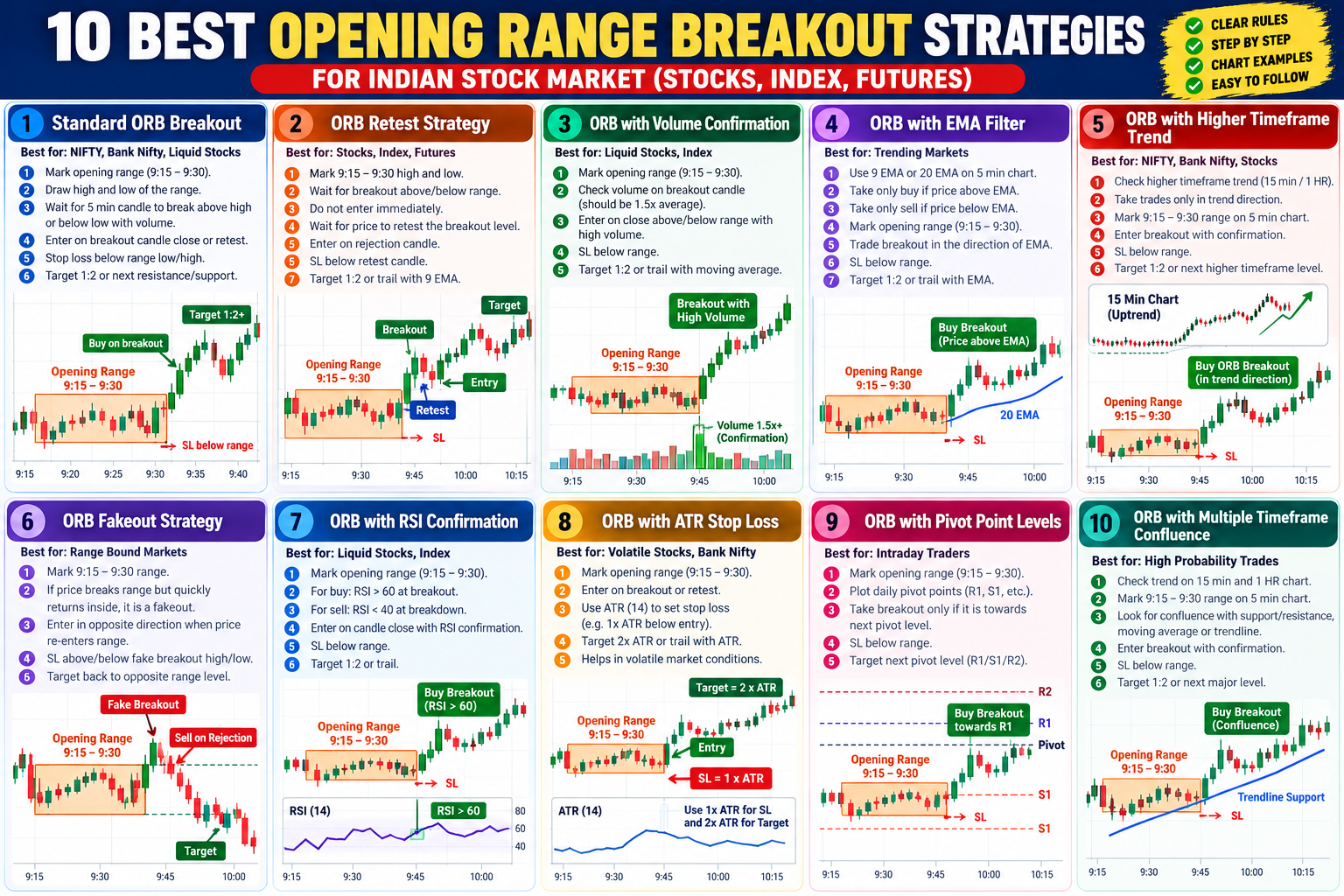
10 Opening Range Breakout (ORB) Trading Strategies for the Indian Stock Market.
Opening Range Breakout is an intraday trading method in which traders mark the high and low of an initial market-opening period and watch for a breakout, breakdown, or retest.
For Indian markets such as NSE stocks, Nifty 50 and Bank Nifty, ORB can be studied using 5-minute, 15-minute or 30-minute candles. The key is to wait for confirmation, define the stop-loss and avoid chasing false breakouts.
Important: No ORB strategy guarantees profits. The setups below are educational frameworks to backtest, not guaranteed buy/sell signals.
Before you start: the basic ORB setup

Step 1 — Choose the opening range
Observe the market from 9:15 AM. Choose a 5-, 15- or 30-minute opening range, according to the setup you want to test.

Step 2 — Mark the range
Draw a horizontal line at the opening-range high (ORH) and another at the opening-range low (ORL).

Step 3 — Wait for confirmation
Look for a candle close outside the range, supportive volume, market context and, where applicable, a successful retest.
The 10 best ORB strategies — step-by-step

The following strategies are variations of ORB. Start by testing one or two setups rather than trading all ten simultaneously.
1. Standard Opening Range Breakout

Best for: Liquid NSE stocks and index charts.
- Open a 5-minute chart at 9:15 AM.
- Mark the high and low of the first 15 minutes, ending at 9:30 AM.
- Wait for a 5-minute candle to close above the range high for a potential long trade, or below the range low for a potential short trade.
- Prefer a breakout supported by volume and a clear price move.
- Place the stop-loss below the breakout candle or inside the range, according to your tested rules.
- Plan the exit using a 1:2 risk-to-reward target or a nearby support/resistance level.
2. ORB Breakout and Retest

Best for: Traders who prefer confirmation instead of chasing a breakout.
- Mark the first 15-minute high and low.
- Wait for price to close above the range high.
- Do not enter immediately.
- Wait for price to return toward the broken level.
- Look for a bullish rejection candle or another predefined confirmation.
- Consider entry after confirmation, with the stop below the retest swing low.
- Use a predefined profit target, such as 1:2 risk-to-reward.
Reverse the rules for a downside breakout.
3. ORB With Volume Confirmation

Best for: Identifying breakouts with stronger market participation.
- Mark the opening range.
- Observe recent volume bars and the stock’s normal activity.
- Wait for a candle to close outside the range.
- Compare breakout volume with a recent average, such as the average of the previous 20 candles.
- Prefer a breakout with clearly stronger-than-normal volume.
- Set a stop-loss at a predefined invalidation level.
- Avoid entering if the breakout candle is excessively extended.
A volume spike supports the setup but does not guarantee continuation.
4. ORB With the 20 EMA Filter

Best for: Trend-aligned intraday trades.
- Add the 20 EMA to a 5-minute chart.
- Draw the opening range.
- Consider long setups when price is above the 20 EMA and the EMA is rising.
- Consider short setups when price is below the 20 EMA and the EMA is falling.
- Wait for a confirmed range breakout in the same direction.
- Set the stop-loss based on the breakout structure.
- Exit at a planned target or use a tested trailing-stop rule.
The EMA is a filter, not a standalone buy or sell signal.
5. Higher-Timeframe Trend + ORB

Best for: Traders who want to align entries with a broader trend.
- Check the 15-minute or 1-hour chart.
- Identify the prevailing trend and nearby support/resistance.
- Mark the opening range on the 5-minute chart.
- Prefer upside breakouts when the higher timeframe supports an uptrend.
- Prefer downside breakouts when the higher timeframe supports a downtrend.
- Avoid trades that break directly into a major opposing level.
- Define your stop and target before entering.
6. ORB False-Breakout Reversal
Best for: Studying failed breakouts in choppy markets.
- Mark the opening range.
- Observe price breaking above the high or below the low.
- Wait for price to return inside the range.
- Look for a rejection candle or a confirmed reversal structure.
- Consider a trade in the opposite direction only after confirmation.
- Place the stop beyond the failed breakout extreme.
- Target the midpoint or opposite side of the range, depending on the setup and available reward.
Do not assume every breakout failure will reverse; some breakouts pause before continuing.
7. ORB With RSI Confirmation

Best for: Adding a momentum filter.
- Add RSI with a 14-period setting.
- Draw the opening range.
- Wait for a breakout candle to close beyond the range.
- For a long setup, test whether RSI is above 50 or rising; a threshold such as 60 can be tested for stronger momentum.
- For a short setup, test whether RSI is below 50 or falling.
- Enter only when the price trigger and your chosen RSI rule agree.
- Use a price-structure stop-loss and predefined target.
Avoid using RSI thresholds as universal rules; they should be validated for the instrument and timeframe.
8. ORB With ATR-Based Stop-Loss

investocraft-nmims.blogspot.com
Best for: Adjusting risk to changing volatility.
- Add ATR (14) to your chart.
- Mark the opening range and wait for a valid breakout.
- Choose an entry based on the breakout or retest.
- Use a tested ATR multiple or a structure-based stop to determine the invalidation distance.
- Calculate position size from the maximum rupee risk you can afford.
- Set a target that offers sufficient reward after costs.
- Skip the trade if the required stop makes the position unsuitable for your risk limit.
ATR measures volatility, not the direction of the market.
9. ORB With Daily Pivot Levels

Best for: Planning trades around established support and resistance.
- Calculate or plot daily pivot, R1, R2, S1 and S2 levels.
- Mark the opening range.
- Identify whether the breakout is approaching a pivot level.
- Avoid a long entry immediately beneath strong resistance if there is insufficient upside room.
- Avoid a short entry directly above strong support if there is insufficient downside room.
- Set the stop-loss based on the setup’s invalidation level.
- Use the next meaningful level as a potential target only if the risk-to-reward remains acceptable.
10. Multi-Timeframe ORB Confluence

Best for: Combining several independent pieces of evidence.
- Check the 1-hour chart for the broad trend.
- Check the 15-minute chart for nearby support and resistance.
- Draw the first 15-minute opening range on the 5-minute chart.
- Check whether the breakout aligns with the broader trend.
- Look for additional confirmation from volume, VWAP or the 20 EMA.
- Enter only when the complete setup meets your rules.
- Define the stop-loss, position size and target before entry.
More confirmations do not automatically mean a higher probability of success. Test the combination as a complete system.
Which ORB strategy should you learn first?
| Your objective | Strategy to study first |
|---|---|
| Simple rules | Standard ORB |
| Avoid chasing breakouts | ORB Retest |
| Confirm participation | Volume Confirmation |
| Trade with the trend | 20 EMA Filter |
| Follow broader direction | Higher-Timeframe ORB |
| Study failed breakouts | False-Breakout Reversal |
| Add momentum analysis | RSI Confirmation |
| Adapt stops to volatility | ATR-Based ORB |
| Plan around key levels | Pivot-Level ORB |
| Combine multiple signals | Multi-Timeframe ORB |
Risk-management rules for Indian markets
- Use liquid stocks or index instruments and check spreads before entry.
- Avoid entering during the first few minutes simply because price is moving quickly.
- Predefine your maximum rupee loss per trade and calculate quantity accordingly.
- Include brokerage, taxes, slippage and other trading costs in backtesting.
- Stop trading whe